
Loading...
Join our Facebook Group: Join: Expats in Poland
Loading...
How to join your spouse, parent, or family member in Poland. From the visa application abroad to the residence permit after arrival.
Type D national visa for Poland
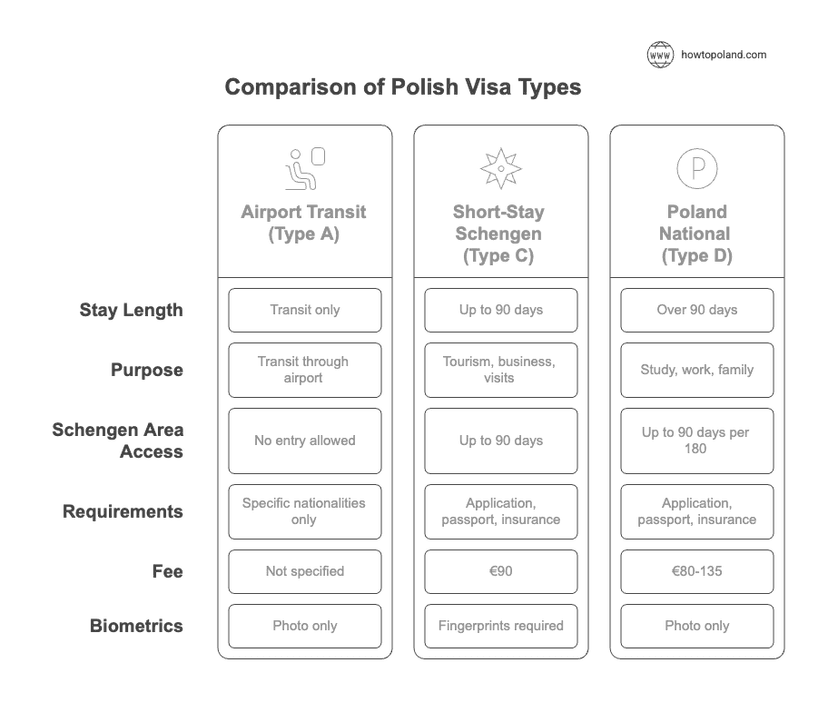
A family reunion visa is a Type D national visa that lets you join a family member who's legally living in Poland - whether they're a Polish citizen, a permanent resident, or hold a temporary residence permit. It's the standard way for spouses, children, and other close relatives to move to Poland and live together as a family.
The process works in two stages. First, you apply for the Type D visa at the Polish consulate in your home country. This gets you into Poland and allows you to stay for up to a year. Once you're in Poland, you apply for a temporary residence permit (karta pobytu) based on family reunification, which is valid for up to 3 years and renewable.
The family reunion visa is one of the more straightforward visa categories in Poland. Unlike a work visa, you don't need a work permit or employer sponsorship - your family relationship is the basis. And once you have a residence permit based on family reunification with a Polish citizen, you can work freely without any additional permits.
Quick summary
Type D visa at the consulate → enter Poland → apply for karta pobytu through MOS → live and work in Poland long-term → path to permanent residence after 5 years.
Not every family member qualifies. Polish law defines specific categories of relatives who can apply for family reunification. The rules differ slightly depending on whether your sponsor is a Polish citizen or a foreigner with a residence permit.
The rules are slightly more restrictive. Your sponsor must hold a residence permit valid for at least 2 more years and demonstrate stable income and housing. Eligible family members are:
Parents and other relatives generally can't get family reunification with a foreign sponsor unless there are exceptional humanitarian circumstances.
Important: If you're married to a Polish citizen and you're already in Poland (e.g., on a tourist visa or work visa), you can skip the consular visa and apply directly for a residence permit through the MOS system. You don't need to leave Poland and apply at a consulate first.
Your sponsor - the family member already in Poland - plays a big role in the application. They need to prove they can support you financially and provide a place to live. Here's what's required:
Your sponsor may also need to appear at the Voivodeship Office in person during the residence permit stage to confirm the family relationship and financial situation.
You'll need to prepare two sets of documents: one for the visa application at the consulate (before you travel), and another for the residence permit application after you arrive in Poland. There's a lot of overlap, so gather everything at once.
Tip: Get everything apostilled and translated before you leave your home country. Finding a sworn translator for your language in Poland can be harder and more expensive. Sworn translations cost 30-60 PLN per page in Poland. You can find certified translators at the Ministry of Justice website.
The family reunion process has two phases: getting the visa at the consulate (while you're still abroad), and applying for a residence permit after you arrive in Poland.
Collect all documents listed above. The most time-consuming part is getting apostilles and sworn translations - start with these first, as they can take weeks in some countries. Your sponsor in Poland should prepare their documents in parallel.
Register on the e-Konsulat portal, fill out the visa application form online, and book an appointment. You can book up to 6 months before your planned travel date. In high-demand countries (India, Philippines, Middle East), appointment slots fill up fast - book as early as possible.
Bring all documents to the consulate. You'll submit your application, provide biometric data (fingerprints and photo), and may be asked questions about your family situation. The consular officer may ask about your relationship, how long you've been married, and your plans in Poland. Answer honestly and consistently with what's in your documents.
Processing takes 15-60 days depending on the consulate. Once approved, collect your passport with the visa sticker. Check the dates on the visa carefully - you can only enter Poland on or after the start date.
After arriving in Poland, register your address (zameldowanie) at the local city hall, get a PESEL number, and open a bank account. Your sponsor should help with this. See our moving to Poland guide for the full checklist.
Don't wait until your visa is about to expire. Apply for a temporary residence permit (karta pobytu) through the MOS system (mos.cudzoziemcy.gov.pl). Since April 2026, all applications are submitted electronically - paper applications are no longer accepted. You'll need a profil zaufany (trusted profile) to log in. See our residence permit guide for the full step-by-step process.
After submitting online, you'll be summoned to the Voivodeship Office for document verification, fingerprints, and a signature sample. You'll receive a stamp in your passport confirming your application - this stamp legalizes your stay while the permit is being processed, even after your visa expires.
Need help with your application?
Get matched for free with a verified, English-speaking immigration specialist in your city.
| Fee | Amount | Notes |
|---|---|---|
| Type D visa (adults) | 80 EUR | Paid at the consulate |
| Type D visa (children 6-12) | 40 EUR | Children under 6 are free |
| VFS/TLS service center fee | 20-30 EUR | If applying through a visa center (varies by country) |
| Temporary residence permit | 340 PLN | Stamp duty, paid after arrival in Poland |
| Karta pobytu card issuance | 50 PLN | For producing the physical card |
| Sworn translations | 30-60 PLN/page | Marriage certificate, birth certificate, etc. |
| Apostille | Varies | Depends on your country (typically 20-100 USD) |
| Travel health insurance | 50-200 EUR | 30,000 EUR minimum coverage, Schengen-wide |
Total cost for a spouse: roughly 150-250 EUR for the visa phase (including translations and insurance), plus about 440 PLN (100 EUR) for the residence permit in Poland. Budget more if your documents need extensive translations.
The total timeline from application to having a residence permit in hand depends on two separate processes:
Visa processing at the consulate: 15-60 days
The official deadline is 15 calendar days, but most consulates take 30-45 days. High-volume consulates in India, the Philippines, or the Middle East can take up to 60 days. Getting an appointment can add another 2-4 weeks on top of that.
Residence permit in Poland: 2-12 months
This varies dramatically by city. In Warsaw, expect 4-12 months. In Krakow, 3-8 months. In smaller cities like Rzeszow or Olsztyn, it can be as fast as 1-3 months. Family reunification cases are generally processed faster than work permits, but don't count on it.
During the residence permit processing, the stamp in your passport keeps your stay legal. You can live and work in Poland even if processing takes months. Apply early and be patient - this is normal in Poland.
Your visa gets you into Poland, but there's a checklist of things to do in your first weeks. Your sponsor should help with most of this, since they already know the system.
Your rights depend on who your sponsor is and what stage you're at in the process.
This is the strongest position. Once you have a residence permit based on marriage to a Polish citizen, you can:
If your sponsor is a foreigner with a residence permit, your rights are more limited:
Children with family reunion visas or residence permits have the right to attend Polish public schools on the same terms as Polish children - that means free education. They can also access free healthcare through their parent's ZUS insurance. For younger children, public kindergartens are available from age 3, though spots can be competitive in larger cities.
It depends on your sponsor. If you're married to a Polish citizen, you can work freely without any additional permits once you have your residence permit (or even while it's being processed with the stamp). If your sponsor is a foreigner with a residence permit, your work authorization will be specified on your own residence permit - in most cases, you'll be authorized to work.
Realistically, 3-6 months for the visa phase (gathering documents + consulate appointment + processing), then another 2-12 months for the residence permit in Poland. Total: 5-18 months from first steps to having a karta pobytu in hand. The good news is you can live and work in Poland from the moment you arrive on the visa - you don't need to wait for the residence permit to start your life there.
No. Polish law only recognizes legally married spouses for family reunification purposes. Poland doesn't have civil partnerships or common-law marriage recognition. If you're in an unmarried relationship, your options are to get married first, or for the partner to enter Poland through a different visa category (such as a work visa or business visa).
If you're already legally in Poland (on a work visa, student visa, or even a Schengen tourist visa), you can apply directly for a temporary residence permit based on family reunification through the MOS system. You don't need to leave and apply for a family reunion visa at a consulate. Just make sure you submit before your current visa or permit expires.
Yes. Children with a family reunion visa or residence permit have the right to attend Polish public schools on the same terms as Polish children, including free education. Most schools offer additional Polish language support for foreign children. Some cities also have international schools, though these are private and charge tuition.
If you're married to a Polish citizen: you can apply for permanent residence after 2 years of continuous residence in Poland (and 3 years of marriage). After that, Polish citizenship is possible after 3 more years. If your sponsor is a foreigner: the standard path is 5 years of continuous residence for permanent residence, then 3 more years for citizenship. Polish language skills (B1 level) are required for permanent residence.
If your residence permit was issued based on marriage and you divorce, the permit won't be automatically revoked, but it may not be renewed on the same basis. You'd need to find another legal basis to stay - such as a work permit, studies, or a new relationship. If you already have permanent residence, divorce doesn't affect your status. It's worth consulting a specialized immigration firm if you're in this situation.
Get matched for free with a verified, English-speaking specialist in your city.
Verified specialists only
We only recommend licensed adwokat and radca prawny registered with the Polish Bar
English-speaking
All partners are fluent in English and experienced with foreign clients
Free matching service
No cost to you - we connect you directly with the right specialist for your case
Immigration specialists
Our partners focus exclusively on immigration law - not generalists