Loading...
Join our Facebook Group: Join: Expats in Poland
Loading...
Whether you're bringing a foreign license or starting from scratch, this guide covers everything: when you can drive on your existing license, how to exchange it, and how to pass the Polish driving exam.
The first thing most foreigners want to know: can I just drive with my existing license? The answer depends on where it was issued.
If your license was issued in any EU or EEA country, you're good. It's valid in Poland until its expiry date - no exchange needed, no time limit. You can drive, rent cars, and buy insurance with it. When it eventually expires, you renew it through the Polish system (at the Starostwo Powiatowe, your local county office). You can also voluntarily exchange it for a Polish one at any time, which some people do to avoid confusion at traffic stops or when dealing with insurance companies.
If your license was issued outside the EU/EEA, you can drive on it for 6 months from the date you register your residence in Poland (zameldowanie). After 6 months, you must either exchange it for a Polish license or get a new one from scratch. Driving after this 6-month window without a Polish license is treated as driving without a license - fines up to 1,500 PLN and potential vehicle impoundment.
Your foreign license must be in Latin script or accompanied by a certified Polish translation. An International Driving Permit (IDP) from your home country can also serve as a translation and is recognized by Polish police, though it doesn't extend the 6-month deadline.
Important: The 6-month clock starts from your residence registration (zameldowanie), not from when you entered Poland. If you've been living here without registering, you're technically already past the deadline the moment you register. Sort out your license early.
How you exchange your license depends entirely on where it was issued. Poland recognizes three categories: EU/EEA (automatic recognition, no exams), countries with bilateral agreements (exchange without exams), and everyone else (both exams required). Here's a quick overview:
| Country / Region | Exams required? | Total cost | Timeline |
|---|---|---|---|
| EU / EEA | No | ~300 PLN | 2-4 weeks |
| UK (post-Brexit) | No (bilateral agreement) | ~370-400 PLN | 2-4 weeks |
| Ukraine | No (bilateral agreement) | ~350-400 PLN | 2-4 weeks |
| Japan, South Korea | No (bilateral agreement) | ~380-420 PLN | 2-4 weeks |
| USA, Canada | Yes (theory + practical) | ~500-600 PLN | 4-8 weeks |
| India | Yes (theory + practical) | ~500-600 PLN | 4-8 weeks |
| UAE, Gulf States | Yes (theory + practical) | ~500-600 PLN | 4-8 weeks |
| Other non-EU | Yes (theory + practical) | ~500-600 PLN | 4-8 weeks |
Details for each country below.
Exchange is optional and exam-free. Your license is valid in Poland until it expires, so there's no rush. If you do want a Polish card (some people prefer it for insurance or rental car hassles), it's just paperwork:
American and Canadian licenses are valid for 6 months after you register your residence (zameldowanie). After that, you need to exchange - and since neither the US nor Canada has a bilateral agreement with Poland, you'll need to pass both the theory and practical exams.
The good news: you don't need a driving course. Your existing license counts as proof of driving experience, so you skip the 60 hours of mandatory instruction. The process:
The theory exam is the bigger hurdle. Polish road rules differ significantly from North American ones: the right-hand rule at unmarked intersections (yield to traffic from the right), tram priority at every turn, stricter speed enforcement, and all-metric signage. Practice with Polish question bank apps - the exam draws from a published pool and has a 92% pass threshold.
The practical exam shouldn't be a problem if you're a confident driver, but book a lesson or two near the WORD center to get familiar with the exam route and the manual-transmission car (usually a Toyota Yaris). Total cost: ~500-600 PLN. Timeline: 4-8 weeks.
Since Brexit, UK-issued licenses are treated as non-EU, so they're valid for only 6 months after residence registration. However, Poland and the UK have a bilateral agreement - you can exchange without taking any exams.
The process is the same as for EU licenses: medical cert, submit at the Starostwo, pay ~100 PLN, collect after 2-4 weeks. Your UK license will be sent back to the DVLA. Add ~70 PLN for a certified translation.
A few things British drivers should prepare for: driving on the right (obviously), roundabouts going counter-clockwise, speed limits in km/h rather than mph (50/90/120/140), and Poland's near-zero alcohol limit (0.2 promille vs 0.8 in the UK). If your car still has UK plates and right-hand drive, you can legally drive it, but many Brits find it uncomfortable on narrow Polish city streets.
Total cost: ~370-400 PLN. Timeline: 2-4 weeks.
Ukraine has a bilateral agreement with Poland, so Ukrainian licenses can be exchanged without exams. Given the large Ukrainian community in Poland (over 1 million residents), Starostwo offices - especially in Warsaw, Wroclaw, Krakow, and Gdansk - are very familiar with this process and handle it routinely.
You'll need a certified Polish translation of your Ukrainian license. This is widely available - most sworn translators in Polish cities offer Ukrainian, and it typically costs 50-80 PLN. The rest is standard: medical certificate, original license + translation, passport, PESEL, photo, submit at the Starostwo.
For Ukrainians under temporary protection: the same exchange rules apply. Your license can be used for 6 months after registering residence, and exchanged without exams at any point. Total cost: ~350-400 PLN. Timeline: 2-4 weeks.
India doesn't have a bilateral agreement with Poland, so exchange requires both theory and practical exams - the same process as for US/Canadian licenses. You'll need a certified Polish translation of your Indian license from a sworn translator.
One thing to note: Indian licenses issued by different states may look quite different. The sworn translator will handle that, but make sure your license is current and has a clear expiry date. Some older Indian licenses were issued without expiry dates, and this can cause delays at the Starostwo. The theory exam is available in English. Total cost: ~500-600 PLN. Timeline: 4-8 weeks.
Licenses from the UAE, Saudi Arabia, Qatar, Kuwait, Bahrain, and Oman don't benefit from bilateral agreements with Poland. Exchange requires both exams, same as the US/Canada process. The theory exam is available in English at all WORD centers.
Key adjustments for Gulf drivers: speed limits are significantly lower (50 km/h in cities vs 60-80 in Gulf cities), alcohol is strictly regulated (0.2 promille limit), and winter driving is a real factor - ice, snow, and shorter daylight hours from November to March are things you won't have dealt with before. Consider winter driving lessons if you arrive in colder months.
Both countries have bilateral agreements with Poland - exchange is straightforward, no exams needed. The process is the same as for EU exchanges, just add a certified translation. Japanese and Korean translations cost a bit more (80-120 PLN) since fewer sworn translators offer these languages compared to English or Ukrainian. Total cost: ~380-420 PLN. Timeline: 2-4 weeks.
For licenses from Brazil, Turkey, Australia, New Zealand, most of Africa, and other countries not listed above: both exams are required. The process is the same as described for US/Canada - certified translation, medical cert, PKK, theory exam (available in English), practical exam, then exchange at the Starostwo. Check the Ministry of Infrastructure website for the current list of bilateral agreements, as new ones are occasionally added.
Tip:Regardless of your country, start the process early. Don't wait until the 6-month deadline - gathering documents, booking the medical exam, and scheduling WORD exams can eat up several weeks, especially in larger cities where WORD centers have longer waiting times.
If you don't have a license to exchange - or if you've never driven before - you can get a Polish license from scratch. You'll need a PESEL number first (get one through address registration).
The full process takes about 2-3 months and costs 2,500-3,500 PLN total. Here's how it works:
Same as for exchange - visit an authorized doctor, get checked, pay ~200 PLN. Standard Category B certificates are valid for 15 years.
Go to the Starostwo Powiatowe (your local county office - every district has one) with your passport, PESEL, medical certificate, and a passport photo. They'll create your PKK number - you'll need this for everything that follows (driving school registration, exam bookings).
The mandatory course includes 30 hours of theory and 30 hours of practical driving. Cost: 2,000-3,000 PLN depending on the city and school. Warsaw and Krakow tend to be more expensive.
Some schools offer instruction in English - ask before enrolling. In bigger cities like Warsaw, Krakow, and Wroclaw, there are usually a few options. The theory part can often be done online, while practical lessons are spread over several weeks (typically 2-3 lessons per week).
After completing the theory portion of your course, take the exam at WORD. See details below.
After passing theory and completing all practical lessons, take the driving exam at WORD. See details below.
After passing both exams, your license is produced and sent to your local Starostwo (county office) for collection. Takes about 2 weeks. You receive a standard EU-format Category B license, valid for 15 years. You can also access a digital copy through the mObywatel app.
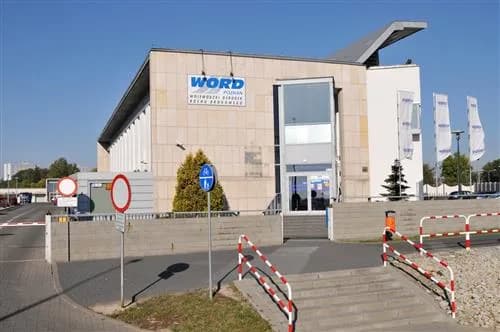
Both exams are taken at WORD (Wojewodzki Osrodek Ruchu Drogowego - Provincial Road Traffic Center). These are government exam centers, not driving schools. You book slots online through the WORD website or by phone. Theory first, then practical - you can't take the practical until you've passed theory.
WORD centers exist only in voivodeship capitals (provincial capitals) - there are 16 in Poland, plus some branch locations in larger cities. If you live in a smaller town, you'll need to travel to the nearest voivodeship capital. For example, if you live in Zakopane, your nearest WORD is in Krakow (about 100 km away). If you're in Elblag, you go to Olsztyn.
The main WORD centers: Warsaw, Krakow, Wroclaw, Poznan, Gdansk, Lodz, Katowice, Lublin, Bialystok, Szczecin, Rzeszow, Bydgoszcz, Olsztyn, Kielce, Opole, Zielona Gora, and Gorzow Wielkopolski. Some voivodeships also have branch offices (oddzialy) in smaller cities - check your local WORD website for locations.
Arrive at least 15-20 minutes before your scheduled time. Bring your ID (passport or residence card) and your PKK number. The WORD building typically has a waiting area with screens showing the queue and room assignments. You check in at the reception desk, confirm your identity, and wait to be called. For the theory exam, you'll be directed to a computer room. For the practical exam, you'll meet your examiner near the vehicle parking area.
The staff at WORD centers generally don't speak English, so if you're not comfortable in Polish, consider bringing someone who can help with the check-in process. The theory exam itself is available in English on the computer, so language isn't an issue once you're seated.
You sit at a computer terminal in a room with other candidates. The exam is computerized: 32 questions, 25 minutes. Available in English at all WORD centers since 2016. You select the English version on the screen before starting. The exam has 20 yes/no questions (3 points each) and 12 multiple-choice questions (varying points). Total: 74 points possible, you need 68 to pass (92%).
Questions show short video clips or images of traffic situations - you watch a clip, then answer what the driver should do. Some questions display a road sign and ask what it means. The timer counts down on screen. When you finish (or time runs out), your result appears immediately - pass or fail, with your score. If you pass, you can book the practical exam right away at the reception desk.
The pass rate for first attempts is around 50-60% - don't underestimate it. Focus on these topics where foreigners trip up most:
The exam pulls from a published question pool of about 3,600 questions - practice with apps that have the full bank in English (search for "Polish driving theory test" in your app store). No waiting period between retakes if you fail.
About 40 minutes total. You drive a WORD-provided exam car - usually a Toyota Yaris or similar compact, manual transmission (left-hand drive, like all cars in Poland). The examiner sits in the passenger seat with a tablet where they record your performance.
The exam has three parts:
Common fail reasons: not checking mirrors enough (examiners are very strict about this - exaggerate your head movements), going even 5 km/h over the speed limit (automatic fail), not yielding to trams, stalling multiple times, and not stopping fully at stop signs. The exam is conducted in Polish, but you can bring an interpreter at your own cost - arrange this beforehand with the WORD office.
After the drive, the examiner tells you the result on the spot. If you pass, you're done - go to the Starostwo to apply for your license. If you fail, you can rebook immediately, though waiting times at popular WORD centers can be 2-4 weeks.
Tip: If you already know how to drive, book a few lessons with a driving school specifically around the WORD exam route. Instructors know exactly which roads examiners use and what they look for. A few targeted lessons are worth more than hours of general practice. Also practice the maneuver course at the WORD grounds if your school allows it - the dimensions and markings are standardized but feeling them in person helps.
| Item | Exchange | New license |
|---|---|---|
| Medical certificate | ~200 PLN | ~200 PLN |
| Certified translation | 50-100 PLN (non-EU only) | n/a |
| Driving course (30h theory + 30h practical) | n/a | 2,000-3,000 PLN |
| Theory exam | ~50 PLN (non-EU without agreement) | ~50 PLN |
| Practical exam | ~140 PLN (non-EU without agreement) | ~140 PLN |
| License issuance fee | ~100 PLN | ~100 PLN |
| Total | 300-600 PLN | 2,500-3,500 PLN |
EU license exchange is the cheapest (no exams, no translation) - about 300 PLN total. Non-EU exchange without exams (reciprocal agreement countries) is similar. Non-EU exchange with exams adds about 200 PLN for the exam fees. A full new license is the most expensive due to the mandatory driving course.
If you're driving in Poland - whether your own car or one you just bought - you need insurance. Driving without it means fines up to 7,400 PLN and personal liability for all damages.
OC (odpowiedzialnosc cywilna) is mandatory for every vehicle on Polish roads. It covers damage you cause to other people and their property. Cost: 400-2,000 PLN per year depending on engine size, your age, driving history, and city. Foreigners without a Polish claims history typically pay more in the first year or two.
If you buy a used car, the seller's OC transfers to you automatically for the remaining policy period. You'll need to arrange your own before it expires. You can keep the existing policy and renegotiate, or switch to a new insurer.
AC (autocasco) covers damage to your own car: theft, vandalism, weather, and at-fault accidents. It's optional but worth considering for newer or more expensive cars. Cost: typically 2-5% of the car's value per year. Most policies have a deductible.
Major insurers: PZU (largest, most physical offices), Warta, Ergo Hestia, Allianz, and Link4 (online-only, often cheapest). Prices vary wildly between companies for the same coverage - use comparison sites like rankomat.pl or mubi.plto compare quotes. You'll need your PESEL and vehicle registration documents. Some comparison sites work in English; otherwise, Link4 has an English-language option.
Most insurers offer roadside assistance (Assistance) as an add-on for 50-150 PLN/year. It covers towing, flat tires, dead battery, lockouts, and a replacement car. Worth adding if you drive often or outside cities.
Even if you're an experienced driver, Polish road rules have a few quirks worth knowing before you get behind the wheel.
Speed cameras are common, especially on national roads. Fines are steep - starting from 400 PLN for exceeding the limit by 11-20 km/h, and going up to 5,000 PLN for exceeding by 50+ km/h. Since 2022, repeat offenders face doubled fines.
The legal blood alcohol limit is 0.2 promille (0.02%) - one of the lowest in Europe. In practice, this means zero drinking and driving. Even a single beer can put you over. Penalties are severe: fines from 5,000 PLN, license suspension, and criminal charges for levels above 0.5 promille. There are frequent police checkpoints, especially on weekends and holidays.
Winter tires aren't legally mandatory in Poland (unlike Germany or Austria), but driving on summer tires in snow or ice can be considered reckless driving and may affect your insurance claim if you're in an accident. Most locals switch to winter tires between November and March. Tire change services cost about 60-100 PLN per set.
Most Polish motorways are toll-free for cars under 3.5 tons since mid-2023. A few privately operated stretches still charge tolls (notably parts of the A1 and A4). You pay at toll booths with cash or card, or via the e-TOLL system app.
Poland uses a penalty points system. You start with 0 and accumulate points for violations. At 24 points (20 for drivers with less than 1 year of experience), your license is suspended and you must retake the exam. Points expire after 1 year (previously 2 years, changed in 2024). Common violations: speeding (up to 15 points), running a red light (15 points), using a phone while driving (12 points).
Most Polish cities have paid parking zones (Strefa Platnego Parkowania) in city centers. You pay via parkometers (coins or card) or mobile apps like SkyCash, mPay, or Parknow. Rates vary by zone - Warsaw's center charges up to 7.20 PLN/hour. Not paying or overstaying means a fine of 50-300 PLN tucked under your windshield wiper. Shopping center garages usually offer 1-2 hours free with a purchase receipt.
If you're involved in a traffic accident or collision (stluczka):
Keep a printed accident statement form in your glove compartment - in the stress of the moment, you won't want to be downloading PDFs.
EU/EEA licenses are valid indefinitely (until they expire). Non-EU licenses are valid for 6 months after you register your residence. An International Driving Permit can help as a translation but doesn't extend the 6-month deadline.
The theory exam is available in English at all WORD centers. The practical exam is conducted in Polish, but you can bring an interpreter at your own cost, or use a translation app. Some driving schools in major cities offer English-speaking instructors.
EU/EEA license holders don't need any exams. Non-EU holders from countries with bilateral agreements (Japan, South Korea, Ukraine, UK) also don't need exams. Everyone else needs to pass the theory exam and usually the practical exam too.
No. You need a PESEL to create your PKK (candidate driver profile). If you don't have one, register your address (zameldowanie) first - you'll get a PESEL automatically.
Driving with an expired or invalid foreign license is treated as driving without a license. Fines go up to 1,500 PLN, your vehicle may be impounded, and it can affect your insurance coverage in case of an accident.
A basic driving medical from an authorized doctor (lekarz uprawniony do badan kierowcow). They check vision, hearing, and general health. It takes 15-20 minutes, costs ~200 PLN, and the certificate is valid for 15 years. You can find authorized doctors through your local Starostwo or simply by searching online for "badania lekarskie kierowcow" + your city.
Yes. Once you have a Polish driving license, it appears in the mObywatel app (Poland's government identity app). Polish police accept the digital version during traffic stops. However, you still need the physical card for car rental and when driving abroad.
Yes. OC (third-party liability insurance) is mandatory for every vehicle. Driving without it means a fine up to 7,400 PLN and personal liability for damages. If you buy a used car, the previous owner's policy transfers to you for the remaining period, but you need to arrange your own before it expires.
Yes, but it affects your license. If you take the practical exam in an automatic car, your Polish license will be restricted to automatics only (code 78). If you take it in a manual, you can drive both. The standard WORD exam car is a manual. Some WORD centers offer automatic exam cars on request, but not all.
18 for a standard car license (Category B). You can start the driving course at 17 years and 9 months, and take the exam from age 18. For motorcycles (Category A1), the minimum age is 16.
Yes. Poland has an extensive network of fixed speed cameras operated by CANARD (Centrum Automatycznego Nadzoru nad Ruchem Drogowym). They're marked with warning signs. Fines arrive by mail and must be paid even by foreign-registered vehicles. Average speed cameras (odcinkowy pomiar predkosci) are also used on some road sections.