Loading...
Join our Facebook Group: Join: Expats in Poland
Loading...
Compare credit cards in Poland for expats in 2026. Cashback, travel rewards, low fees, English applications. Side-by-side comparison of mBank, Millennium, Citi Handlowy, PKO and ING - including which cards approve foreigners fastest and which need zero Polish.

Digital banking users and cashback seekers

Digital banking users and cashback seekers
First-time credit card users and travelers
First-time credit card users and travelers

Frequent travelers and premium users

Frequent travelers and premium users
Expats who want an international brand and English-first service
Expats who want an international brand and English-first service

International online shoppers

International online shoppers

High-income professionals and luxury seekers

High-income professionals and luxury seekers
Side-by-side view of the most popular credit cards in Poland for foreigners. All six cards offer English support and online applications - the differences come down to fees, credit limits and which one approves you fastest.
| Card | Annual fee | Min. income | Credit limit | English | Best for |
|---|---|---|---|---|---|
| mBank Visa | 0 PLN | 2,500 PLN | Up to 50,000 PLN | Full | Cashback & digital banking |
| PKO Visa | 0-120 PLN | 2,000 PLN | Up to 100,000 PLN | Full | First card & high limits |
| Santander | 0-200 PLN | 4,000 PLN | Up to 80,000 PLN | Full | Travel rewards |
| Citi Handlowy Simplicity | 0 PLN | 2,500 PLN | Up to 60,000 PLN | Full | International brand & no late fees |
| ING Visa | 0 PLN | 3,000 PLN | Up to 40,000 PLN | Full | International online shopping |
| Millennium Mastercard | 0-300 PLN | 8,000 PLN | Up to 200,000 PLN | Full | High earners & luxury perks |
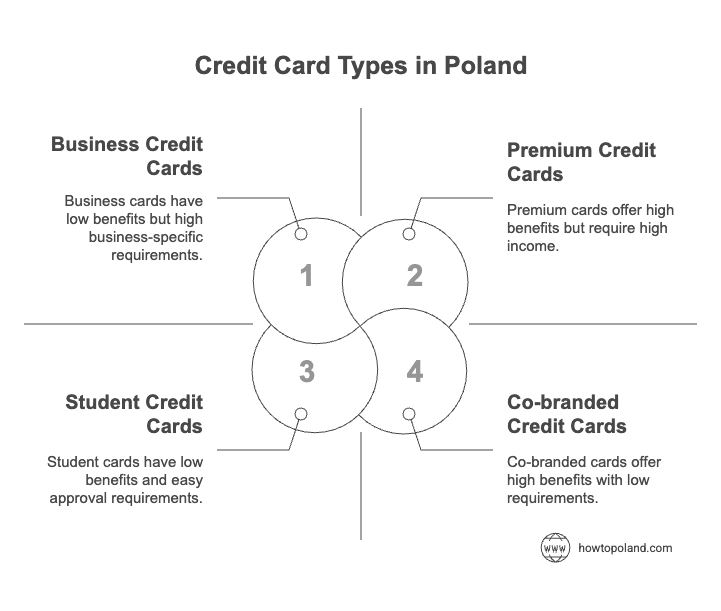
Polish credit cards fall into several distinct categories, each designed for different spending habits and financial situations. Unlike some countries where credit cards are the primary payment method, Poland still relies heavily on debit cards for daily transactions. However, credit cards are becoming increasingly popular among younger professionals and expats who appreciate the flexibility and rewards programs.
The credit card market in Poland is dominated by Visa and Mastercard, with American Express having limited acceptance outside major cities. Most Polish credit cards offer contactless payments (called "zbliżeniowe" in Polish), which is essential since many merchants have minimum amounts for traditional chip-and-PIN transactions.
Standard credit cards are the most common type in Poland, typically offering credit limits between 5,000-20,000 PLN depending on your income. These cards usually have no annual fee or a low fee (0-50 PLN), making them accessible to most working professionals. The interest rates range from 15-25% APR, which is relatively high compared to Western European standards but typical for the Polish market.
Banks like PKO, mBank, and ING offer competitive standard cards with basic rewards programs. Most include fraud protection, online shopping insurance, and 24/7 customer support. The application process typically takes 3-7 business days, and you'll need to show proof of income (usually a minimum of 2,000-2,500 PLN monthly salary).
Premium credit cards in Poland target higher-income customers with monthly salaries above 4,000-5,000 PLN. These cards offer enhanced benefits like travel insurance, airport lounge access, concierge services, and higher cashback rates (typically 1-3% on purchases). Annual fees range from 100-300 PLN, but many banks waive the fee if you spend a certain amount annually.
Santander's World Elite and Millennium's Platinum cards are popular choices among expats working in corporate roles. These cards often include additional perks like extended warranty protection, car rental insurance, and priority customer service in English. Credit limits can reach 50,000-100,000 PLN for qualified applicants.
The newest category includes cards from digital banks like mBank and ING, which have gained significant popularity among Polish millennials and expats. These cards typically offer instant approval for existing customers, low or zero foreign transaction fees, real-time spending notifications, and competitive exchange rates for international purchases. Digital cards often come with innovative features like spending categorization, budget tracking, and the ability to freeze or unfreeze your card instantly through a mobile app.
For expats, these cards are particularly attractive because they offer full English support, transparent fee structures, and don't require extensive Polish banking history. However, acceptance can be limited at smaller merchants who prefer traditional Polish bank cards.
Getting a credit card in Poland as a foreigner is straightforward if you have a Polish bank account and regular income. Most banks require 3-6 months of banking history, but digital-first banks like mBank and ING can approve applications instantly for existing customers. You'll need your passport, proof of Polish address, and recent pay slips showing at least 2,000 PLN monthly income.
EU citizens typically get faster approval since banks view them as lower risk. Non-EU citizens might face stricter requirements, including a longer employment history (6-12 months) and higher income thresholds. Banks like mBank and PKO have English-speaking staff who understand expat situations and can guide you through the process.
Start with a standard card from your existing bank - they already know your financial situation. Once you build credit history in Poland (usually 12 months), you can apply for premium cards with better rewards and higher limits.
Which card for which expat? If you want the best fully-digital experience in English with cashback, start with mBank. If you prefer an international brand and zero late fees, Citi Handlowy Simplicity is the most expat-friendly card on the Polish market. For the highest credit limits and premium perks, Millennium targets high earners.
When you open a Polish bank account, you'll automatically get a debit card (karta debetowa) for free. But should you also apply for a credit card? The choice isn't obvious because Polish banking culture differs significantly from countries like the US or UK, where credit cards dominate daily spending.
Here's the reality: 80% of Polish transactions happen with debit cards, not credit cards. Most locals prefer spending their own money rather than borrowing, which means credit cards are mainly used for emergencies, online shopping, or building credit history. As an expat, understanding when to use each type will save you money and help you integrate better into Polish financial culture.
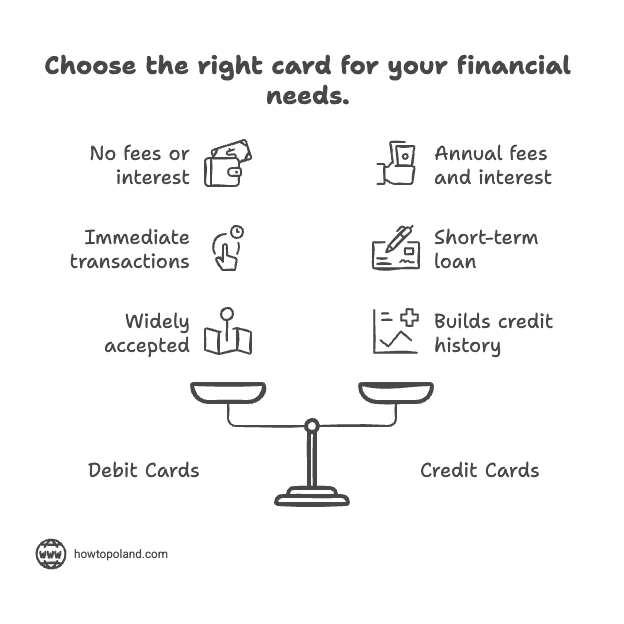
Debit cards in Poland work exactly like they do worldwide - they're directly connected to your bank account and deduct money immediately when you make a purchase. Every Polish bank account comes with a free debit card, usually Visa or Mastercard, which you can use at any shop, restaurant, or ATM across Poland and Europe.
Polish debit cards are perfect for daily expenses like groceries, public transport, and dining out. Most merchants prefer debit cards over cash, especially for contactless payments under 100 PLN ($24 / €22). You'll get your debit card within 5-7 days of opening your account, and it's completely free with most Polish banks like PKO, mBank, or ING.
Credit cards in Poland work like a short-term loan - you borrow money from the bank to make purchases, then pay it back later with interest if you don't pay the full amount by the due date. Unlike debit cards, credit cards require a separate application process and income verification, typically requiring at least 2,000-2,500 PLN monthly salary.
Polish credit cards are ideal for building credit history, earning rewards, and handling larger purchases or emergencies. They also offer better fraud protection and are preferred for online shopping and international travel. However, they come with annual fees (0-300 PLN) and high interest rates (15-25% APR) if you carry a balance.
As a newcomer to Poland, start with a debit card from your chosen bank - it's free, immediate, and covers all your daily needs. Most expats find that a debit card handles 90% of their transactions in Poland, from grocery shopping at Biedronka to paying for trams in Warsaw or Krakow.
After 3-6 months of banking history, consider applying for a credit card if you want to build Polish credit, earn cashback, or need the extra security for online purchases. Digital-first banks like mBank offer instant credit approval for existing customers, while traditional banks like PKO or Santander provide more comprehensive credit-building opportunities.
Many Polish merchants still prefer debit cards over credit cards due to lower processing fees. If you're planning to shop at smaller local businesses or markets, a debit card will always be accepted, while some places might not take credit cards.
| Feature | Debit Card | Credit Card |
|---|---|---|
| Annual fee | Free | 0-300 PLN |
| Credit history | Does not build BIK score | Builds BIK credit history |
| Rewards | None | Cashback 0.5-2%, travel perks |
| Fraud protection | Basic | Better chargeback rights |
| Spending control | Can't overspend | Risk of debt |
| Acceptance | 100% of Polish merchants | Some small shops may not accept |
In Poland, while anyone can apply for a credit card, there are basic requirements that must be met, such as being a Polish resident and being of legal age (18+). Beyond these criteria, credit card providers have additional conditions that applicants must satisfy. The type of credit card you can obtain largely depends on your credit history in Poland.
When applying for a Polish credit card with a credit limit, banks consider this a potential risk and conduct thorough credit checks to evaluate your financial reliability.
When applying for a Polish credit card with a credit limit, banks conduct a credit check through BIK (Biuro Informacji Kredytowej) - Poland's largest credit reporting agency. BIK maintains records of all credit applications, loans, and payment histories for Polish residents, similar to how Schufa operates in Germany.
If you have a negative BIK record due to delayed payments, unpaid bills, or previous loan defaults, your chances of approval for a traditional credit card are significantly reduced. Banks need assurance that customers can repay borrowed money in a timely manner, making your credit history crucial for approval.
However, debit cards and prepaid credit cards are usually issued without a BIK check. Since these cards don't offer actual credit, they don't pose significant risk to banks while still providing essential payment features including contactless transactions and ATM withdrawals.
With traditional credit cards in Poland, holders must expect interest charges when using flexible repayment options. If you don't pay the full credit card bill within the interest-free period (usually 25-55 days) and choose installment payments instead, interest rates typically range from 15-25% APR.
Interest rates vary significantly between providers. Additional fees may apply for foreign currency transactions, ATM withdrawals, or annual membership fees. Some premium cards waive annual fees if you spend above certain thresholds annually.
| Fee type | Typical range | Notes |
|---|---|---|
| Annual fee | 0-300 PLN | Premium cards charge more; many waive fees with min. spending |
| Foreign currency | 1.5-4% per transaction | Digital banks like mBank and ING usually offer better rates |
| Cash withdrawal | 5-15 PLN + 2-4% | Some banks offer free withdrawals at their own ATM network |
Polish credit cards typically provide monthly credit limits ranging from 5,000-50,000 PLN ($1,200-$12,000 / €1,100-€11,000) depending on your income and credit history. Traditional credit cards offer the option to repay borrowed amounts in monthly installments, but this comes with interest charges on the outstanding balance.
Interest rates in Poland are variable and charged only on the borrowed amount, not the entire credit limit. When comparing credit card offers, focus on the effective annual interest rate (RRSO in Polish) rather than just the nominal rate, as this gives a complete picture of total interest costs.
If you're new to Poland and lack local credit history, consider starting with a secured credit card or building your BIK score through consistent debit card usage and bill payments before applying for premium credit cards with better terms.
When you first arrive in Poland, you have no BIK (credit bureau) history at all. Banks see an empty file, which makes credit card approval harder - they simply have no data to judge your reliability. The good news is that building a Polish credit record is straightforward if you follow a deliberate strategy. Most expats can go from zero history to credit card approval in 3-6 months.
Your first move is opening a Polish bank account (see our bank accounts guide). Once you have one, use it actively: set up direct deposit for your salary, pay rent via bank transfer, and use your debit card for everyday purchases. Banks track internal account activity even before BIK does, so 3-6 months of steady salary deposits and regular spending show the bank you're financially stable.
Put utility bills (electricity, gas, internet) in your name and pay them on time through your Polish bank account. While utility payments don't directly appear in BIK, some banks and telecom companies do report payment history to complementary databases like ERIF or KRD. Consistent on-time payments across all obligations create a pattern that banks look for when evaluating your application.
The fastest way to build a BIK record is to take out a small, manageable credit product and repay it perfectly. Options include: a phone installment plan from Play, Orange, or T-Mobile (they report to BIK), a small consumer loan of 1,000-3,000 PLN from your bank, or a store credit for an appliance purchase. The key is to make every payment on time - even one late payment can set you back significantly.
After 3-6 months of active banking and at least one completed credit obligation, apply for a credit card at the bank where you already have your account. Existing customers have a much higher approval rate because the bank can see your salary history and spending patterns internally. Start with a standard card - don't aim for premium products on your first application. Once approved, use the card for small regular purchases and always pay the full balance each month to avoid interest charges while building your BIK score further.
Timeline: Months 1-2: open account, receive salary, use debit card. Months 2-4: take a small installment plan (phone or consumer loan). Months 4-6: apply for a credit card at your bank. Months 6-12: use credit card responsibly to build a strong BIK score. After 12 months of positive history, you qualify for premium cards with higher limits.
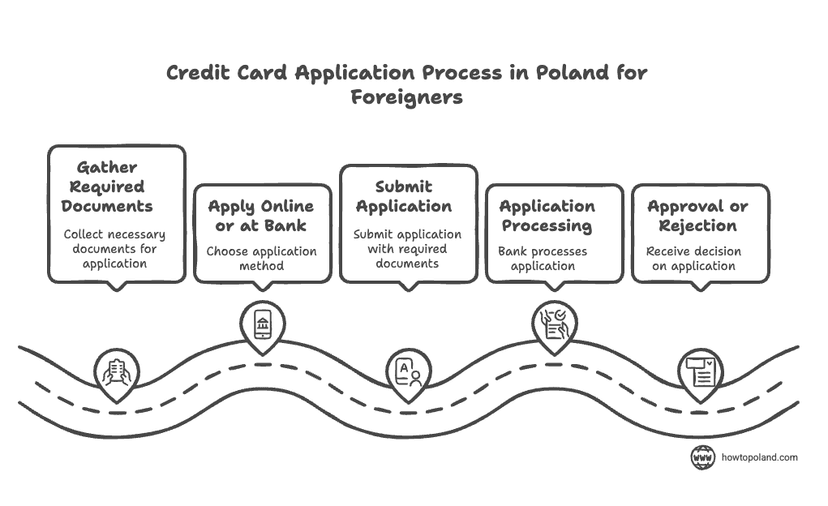
Getting a credit card in Poland as a foreigner requires more documentation than opening a basic bank account. The application process typically takes 3-14 days, depending on whether you apply online with digital-first banks like mBankor through traditional banks like PKO Bank Polski. Below you'll find the specific requirements for EU and non-EU citizens, how income verification works, and a comparison of online vs. in-person application methods.
Credit card applications require more documentation than debit cards since banks need to verify your ability to repay credit. Here's what you'll need to prepare:
EU citizensneed a valid European ID card or passport, proof of Polish address (rental contract or utility bill), a PESEL number, an employment contract or business registration, the last 3 months' pay slips showing at least 2,000 PLN monthly income, and bank statements from a Polish account covering 3-6 months. The process is generally faster for EU nationals since banks view them as lower-risk borrowers.
Non-EU citizensface stricter requirements: a valid passport with at least 6 months remaining, a residence permit or long-term visa, PESEL number, employment contract with at least 6 months of history, the last 3 months' pay slips showing at least 2,500 PLN monthly income, Polish bank account statements (6+ months preferred), and proof of address registration. Some banks may also request a copy of your work permit.
Digital-first banks like mBank and ING may approve credit cards faster for existing customers, while traditional Polish banks typically require 3-6 months of local banking history. Citi Handlowy is also known for being more flexible with foreign applicants thanks to its international expat-banking heritage.
Polish banks have strict income requirements for credit cards. Your monthly salary determines both approval chances and credit limit. Here's what different banks typically require:
2,000 PLN
($480 / €440)
Minimum monthly income
Credit limit: 3-5x monthly salary
4,000 PLN
($960 / €880)
Minimum monthly income
Credit limit: 5-8x monthly salary
1,500 PLN
($360 / €330)
Minimum monthly income
More flexible verification
If you're self-employed or run a business in Poland, you'll need to provide additional documentation including business registration (KRS/CEIDG), tax returns (PIT), and 6-12 months of business bank statements. Some banks may require 12+ months of business operation history.
Applying online is the fastest route. Banks like mBank offer a full English-language online process that takes 15-30 minutes. You fill in the application form, upload scanned documents (passport, pay slips, employment contract), and complete identity verification via video call or a selfie. Existing customers at digital-first banks often get instant approval without needing to submit any additional paperwork. The main limitation is that not all banks support fully online credit card applications - some still require at least one branch visit for identity verification.
Applying in personis better if you want personal guidance or if your situation is non-standard (self-employed, newly arrived, or unusual income sources). You'll need to book an appointment at a branch - in Warsaw, Krakow, and Wroclaw many branches have English-speaking staff. Bring all your documents in original form. The appointment usually takes 45-90 minutes. The advantage is that the banker can review your documents on the spot and sometimes expedite your application. In smaller cities, English availability can be limited, so consider bringing a Polish-speaking friend or using the Google Translate camera feature for any forms you need to sign.
Getting rejected for a Polish credit card is common among foreigners, especially in the first year. Don't take it personally - it usually means the bank's algorithm didn't have enough data to approve you, not that you're financially unreliable. The most frequent reasons for rejection are: insufficient BIK history (less than 3 months), employment contract shorter than the bank's minimum requirement, income below the threshold for the card you applied for, or too many recent credit inquiries in BIK.
Every credit card application creates an inquiry in your BIK record. If you apply at five different banks in the same week, each bank sees that four others have already checked your file - and that looks desperate. Each rejection makes the next application harder. After a rejection, wait at least 30 days before trying another bank, and ideally 2-3 months. Use that time to strengthen your profile: accumulate more salary deposits, pay off any existing obligations, and make sure all bills are current.
Each bank has different approval criteria. If PKO rejected you, mBank might approve you and vice versa. Digital-first banks like mBank tend to be more flexible with foreigners who have existing accounts there. Another option is to apply for a lower-tier product: instead of a Gold card, try a standard card with a lower credit limit. Some banks also offer secured credit cards (karta kredytowa zabezpieczona) where you deposit money as collateral - these are almost always approved regardless of your credit history.
Polish banks are legally required to explain the reason for rejection if you ask. Call the customer service line (in English at mBank, PKO, or Citi) and ask specifically what factor caused the rejection. Sometimes it's something fixable - for example, your employer's company might not be in the bank's verification database, and providing additional employment documentation would resolve it. You can also request your free BIK report once a year at bik.plto check if there are any errors or negative entries you weren't aware of.
Practical alternative: While building your credit history, consider using Revolut or Wise for international transactions and your Polish debit card for domestic spending. You get most of the convenience of a credit card without needing BIK approval.
If you're getting a credit card in Poland, you'll quickly discover BLIK - a uniquely Polish payment system that's everywhere. Understanding BLIK is crucial for expats because it's how most Poles pay for everything from coffee to online shopping, and it works with both your credit and debit cards.
BLIK is Poland's homegrown mobile payment system that generates 6-digit codes in your banking app for instant payments. Think of it as Poland's answer to Apple Pay, but it works with any smartphone and any Polish bank account - including your new credit card. Over 80% of Polish adults use it regularly. When you're at Żabka (corner shop), ordering food delivery, or shopping online, cashiers will often ask "BLIK?" before mentioning card payments. It's that integrated into Polish culture. Read our full guide to BLIK.
Once you get your Polish credit card, BLIK becomes incredibly useful. You can link both your debit and credit cards to BLIK, then choose which one to use for each payment. This is perfect for managing your spending - use debit for daily expenses and credit for larger purchases or when you want to earn rewards.
Here's what makes BLIK special for credit card users: there are no additional fees from BLIK itself (your bank's credit card terms still apply), it works for online shopping on Polish websites, and you can even withdraw cash from ATMs using just your phone and a BLIK code.
Using BLIK is simple: open your banking app, tap the BLIK section (usually on the main screen), choose whether to pay from your debit or credit card, and generate a 6-digit code that's valid for 2 minutes. Enter the code at the payment terminal or paste it during online checkout, then confirm the payment in your app. The whole process takes about 10 seconds once you get used to it.
You'll use BLIK everywhere in Poland: at grocery stores like Żabka and Biedronka, on Allegro.pl (Poland's equivalent of Amazon), for food delivery through Uber Eats, Glovo, and Pyszne.pl, at public transport ticket machines, for online government services (e-Urząd), and even at parking meters in major cities.
Good to know: Some Polish websites only accept BLIK or traditional bank transfers, not international Visa/Mastercard payments. Having BLIK set up means you can shop anywhere online in Poland without limitations.
Poland is one of the most contactless-friendly countries in Europe. Nearly every payment terminal accepts tap-to-pay, and most Poles use it for everyday purchases. Your Polish credit card comes with contactless capability by default - just tap your card or phone on the terminal and you're done.
The key limit to know: transactions up to 100 PLNgo through without a PIN. Above 100 PLN, you'll need to enter your 4-digit PIN after tapping. For security reasons, after several consecutive contactless payments without a PIN, the terminal will occasionally ask for your PIN regardless of the amount - this is normal and required by EU regulations.
You can also add your Polish credit card to Apple Pay, Google Pay, or Garmin Pay for phone and watch payments. Most Polish banks support all three platforms. Phone payments have higher contactless limits (up to 500 PLN without additional authentication) because biometric verification on your phone counts as a second factor.
When you shop online with a Polish credit card, most transactions require 3D Secure verification (called "Verified by Visa" or "Mastercard Identity Check"). After entering your card details on a website, you'll receive a push notification in your banking app or an SMS code that you need to confirm before the payment goes through.
This is mandatory for all online purchases within the EU under PSD2 regulations. Make sure your phone number is up to date in your banking app - if you changed your number and forgot to update it, you won't be able to confirm online payments. Also keep your banking app updated, as older versions sometimes fail to receive 3D Secure push notifications.
Common issue for expats:If you're using a foreign phone number with your Polish bank account, 3D Secure SMS codes may arrive with a delay or not at all. Switch to push notifications in your banking app instead - they're faster and more reliable than SMS regardless of which country your phone number is from.
Dynamic Currency Conversion (DCC) is a hidden fee trap that catches many expats. Here's how it works: when you pay with your Polish credit card at certain terminals (especially in tourist areas, airports, or hotels), the terminal may ask if you want to pay in your "home currency" instead of PLN. It sounds convenient - seeing the price in EUR or USD. But the exchange rate used by DCC is typically 3-7% worse than your bank's rate.
The rule is simple: always choose PLN.Whether you're paying at a shop in Poland with your Polish card, or using your Polish card abroad, let your bank handle the currency conversion. Polish banks typically charge 1.5-3% for foreign currency transactions, which is still much cheaper than DCC's markup. ING and mBank offer some of the best exchange rates among Polish banks, while Citi Handlowy benefits from competitive global Citi rates.
DCC also appears online. International websites like Booking.com, Amazon, or Ryanair sometimes default to showing prices in your card's detected currency. Before confirming any online payment, check the checkout page for a currency selector and switch it to PLN if you're paying with a Polish card, or to the merchant's local currency if you're paying abroad.
ATM tip:The same DCC trick happens at ATMs abroad. When withdrawing cash with your Polish card outside Poland, the ATM may offer to convert the amount to PLN for you. Always decline and choose to be charged in the local currency. Your bank's exchange rate will almost always be better.
Understanding these Polish credit card terms will help you navigate applications, read contracts, and communicate with bank staff more effectively:
Application tip: Most Polish banks now offer credit card applications in English. mBank and Citi Handlowy provide completely English interfaces for credit card management, with no Polish language skills required.
Important: All USD and EUR conversions shown throughout this page are estimated based on approximate exchange rates and are provided for reference only. Currency exchange rates fluctuate daily and actual costs may vary when paying with foreign cards or converting currency. Always check current exchange rates before making financial decisions.
Yes, foreigners can apply for credit cards in Poland. You'll need a PESEL number, proof of income (minimum 2,000-2,500 PLN ($480-$600 / €440-€550) monthly), and 3-6 months of Polish banking history. EU citizens typically have easier approval processes. mBank and Citi Handlowy are usually the most foreigner-friendly options. See our best bank accounts in Poland for foreigners guide if you don't have a Polish account yet.
First-time credit card holders in Poland typically receive limits of 3-5 times their monthly salary. With a 3,000 PLN ($720 / €660) salary, expect 9,000-15,000 PLN ($2,160-$3,600 / €1,980-€3,300) credit limit. Your limit depends on income, credit history, and employment stability. After 12 months of good payment history, you can request increases.
Yes, several Polish banks offer credit cards with 0 PLN annual fees. mBank, ING and Citi Handlowy Simplicity all offer free credit cards. Premium cards with travel insurance and higher cashback typically charge 100-300 PLN ($24-$72 / €22-€66) annually but may waive fees with minimum spending.
Credit card approval in Poland takes 3-14 business days. Digital-first banks like mBank and ING can approve applications instantly if you're an existing customer. Traditional banks (PKO, Santander, Citi Handlowy) typically take 5-7 days for decision and another 5-7 days for card delivery. Instant digital cards are available for immediate online use.
Missing payments in Poland results in late fees (typically 20-50 PLN ($4.80-$12 / €4.40-€11)), higher interest rates, and negative BIK credit bureau records. After 30 days, it's reported to BIK, affecting future credit applications. Contact your bank immediately if you can't make payments - many offer payment deferrals or restructuring options.
Yes, Polish credit cards work for international online shopping. However, foreign currency fees apply (typically 1.5-4% per transaction). ING and Citi Handlowy generally have the most competitive FX terms among the cards listed here. Always inform your bank about foreign transactions to prevent security blocks.
Yes, many Polish credit cards offer cashback (0.5-2%) or points programs. mBank provides up to 1% cashback on purchases, while premium cards from Santander and PKO offer travel rewards and shopping discounts. Citi Handlowy PremierMiles converts spending into airline miles, and Millennium World Elite offers concierge benefits for high earners.
You'll need: valid passport/ID, PESEL number, proof of Polish address, employment contract, last 3 months' pay slips, and Polish bank statements (3-6 months). Non-EU citizens may need residence permits. Self-employed applicants need business registration and tax returns (PIT).
You need a bank account before applying for a credit card. Compare 9 banks for foreigners.
Need a larger amount? Compare personal loan providers with rates and approval criteria.
Earn up to 7% APY on your savings. Compare term deposits and savings accounts.
Choose from our top-ranked credit cards and start building your credit in Poland. Compare features, rewards, and find the perfect card for your needs.