
Loading...
Join our Facebook Group: Join: Expats in Poland
Loading...
Are you wondering if you qualify for Polish citizenship by descent? Whether your ancestors were Polish Jews, emigrants before 1920, or citizens who left Poland during political upheavals, there's a legal path to restoring Polish citizenship and obtaining a Polish passport. This comprehensive guide covers everything from the crucial 1920 rule to Jewish ancestry considerations, required documents, and step-by-step application process.
If you've uncovered Polish ancestry in your family tree, you might qualify for Polish citizenship by descent. Whether your ancestors were Polish Jews, emigrants before 1920, or citizens who left Poland during political upheavals - there's a legal path to restoring Polish citizenship and obtaining a Polish passport.
The concept of "jus sanguinis" (right of blood) is fundamental to Polish citizenship law. Unlike countries that grant citizenship based on place of birth (jus soli), Poland follows the principle that citizenship is inherited through bloodline. This means that if your Polish ancestor was a citizen at the time of your birth, and they never lost that citizenship, you may already be a Polish citizen without knowing it.
Unlike some countries that limit citizenship by descent to one or two generations, Poland allows citizenship to be passed down through multiple generations, as long as the lineage can be properly documented. This makes it possible for great-grandchildren and even great-great-grandchildren of Polish citizens to claim Polish citizenship. If you're planning to emigrate to Poland, confirming your citizenship first can simplify the entire process.
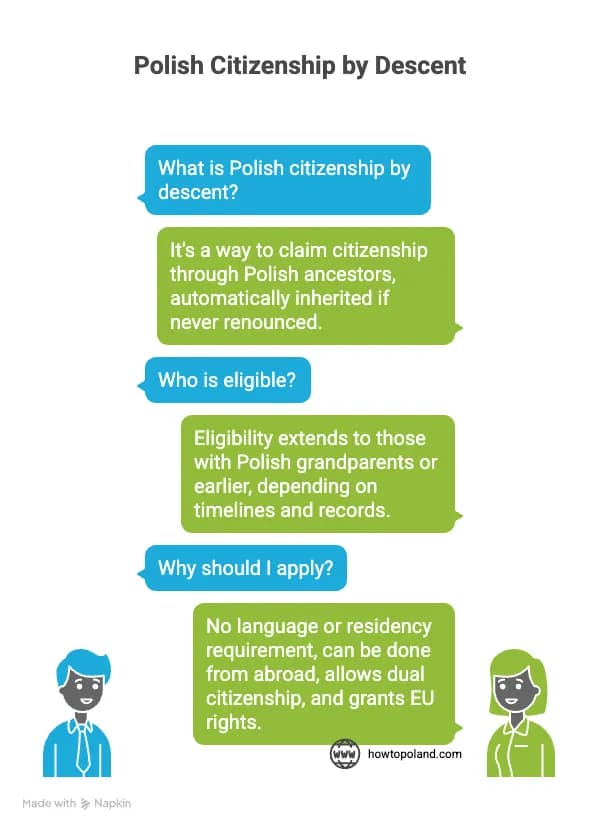
Polish Citizenship by Descent Process
Understanding your family's Polish heritage and citizenship rights
This is particularly important for families who emigrated during World War II, the Communist era, or economic migration waves. Many people assume their ancestors lost Polish citizenship when they left the country, but this isn't always the case. Polish citizenship law has specific rules about when and how citizenship can be lost. For more information about specific historical periods, see our sections on Polish descent after 1920 and before 1920.
One of the most significant advantages of Polish citizenship is that it grants you full European Union citizenship rights. This means you can live, work, study, and retire anywhere in the EU without needing visas or work permits. You can freely find a job in Poland, start a business, or buy property without any restrictions. If you're not eligible for citizenship by descent, you might want to explore Polish citizenship by naturalization, apply for a residence permit, or check other citizenship pathways.
Polish citizenship law has evolved through several major legislative acts. Understanding these laws and their key dates is essential for determining your eligibility, because different rules applied during different periods. The current legal basis is the Act on Polish Citizenship of April 2, 2009 (Dz.U. 2012 poz. 161), which entered into force on August 15, 2012.
| Year | Law / Event | Why It Matters for Your Claim |
|---|---|---|
| 1920 | Act on Citizenship of the Polish State (January 20, 1920) | First Polish citizenship law after independence. Defined who automatically became a Polish citizen - anyone domiciled in Polish territory on January 10, 1920 who was not a citizen of another state. This is the "1920 rule" - the foundation for most descent claims. Also established that citizenship passes to children from their father (or mother if father was unknown). |
| 1951 | Act on Polish Citizenship (January 8, 1951) | Communist-era law. Crucially, it allowed the government to strip citizenship from people who left Poland without permission or stayed abroad beyond their authorized period. Many emigrants (including Holocaust survivors) lost citizenship under this law through collective decrees. If your ancestor lost citizenship this way, the 2009 Act provides a restoration path. |
| 1962 | Act on Polish Citizenship (February 15, 1962) | Replaced the 1951 Act. Introduced the rule that acquiring foreign citizenship causes automatic loss of Polish citizenship (unless permission was granted to retain it). This is key for post-1962 emigrants: if your ancestor naturalized in another country after 1962 without Polish consent, they lost Polish citizenship. Children born after the loss would not inherit it. |
| 2009 | Current Act on Polish Citizenship (April 2, 2009, Dz.U. 2012 poz. 161) | The current law. Key provisions: Art. 4 - a child acquires citizenship if at least one parent is Polish. Art. 6 - acquiring foreign citizenship no longer causes automatic loss of Polish citizenship. Art. 38 - allows restoration of citizenship for those who lost it. Art. 55 - procedure for confirmation of citizenship by descent. |
If your ancestor emigrated before 1951: They likely retained Polish citizenship (the 1920 Act did not automatically strip it for emigration). Your claim follows Art. 55 (confirmation).
If your ancestor was stripped of citizenship between 1951-1999: You may apply for restoration under Art. 38 of the 2009 Act. This applies to many Holocaust survivors and their descendants.
If your ancestor voluntarily acquired foreign citizenship after 1962: They likely lost Polish citizenship automatically. You cannot claim citizenship by descent through them, but may explore restoration or naturalization.
Work through this checklist to determine whether you likely qualify for Polish citizenship by descent. Answer each question in order - if you reach a "stop" point, read the explanation for your specific situation.
If yes, continue. If no, you cannot claim Polish citizenship by descent.
Being born in what is now Poland doesn't automatically mean citizenship - they needed to be domiciled there in 1920 or acquire citizenship through later laws. Check for citizenship documents, passport records, or civil registry entries.
If your ancestor lost citizenship BEFORE the next generation was born, that generation did not inherit it. Check the key dates: voluntary foreign naturalization after 1962 caused automatic loss. Government decrees (1951 Act) also caused loss. If citizenship was lost, explore Art. 38 restoration instead.
You need birth certificates (or equivalent) for every generation between your Polish ancestor and yourself, plus marriage certificates to connect name changes. Each document must show the parent-child relationship.
Under the 1920 Act, citizenship passed primarily through the father. If your connection is through a mother whose husband was not Polish, this may complicate your claim for the pre-1951 period. After 1951, citizenship could pass through either parent.
You likely qualify for confirmation of Polish citizenship under Art. 55 of the 2009 Act. Proceed to the documents section to see what you need, then follow the application process. For complex cases (pre-1920 ancestry, lost citizenship, Jewish ancestry), read the relevant sections below and consider consulting an immigration lawyer in Poland.
The year 1920 is crucial for Polish citizenship claims because it marks when the first Citizenship Act took effect (January 20, 1920). Under this law (Art. 2), anyone domiciled in Polish territory on January 10, 1920 who was not a citizen of another state automatically became a Polish citizen. This created the legal foundation for all subsequent descent claims.
If your ancestor was officially recognized as a Polish citizen after 1920, they could pass that citizenship to their children. The key is proving they were actually Polish citizens (not just born in Polish territory) and that they didn't lose their citizenship through specific legal means.
Many families assume their ancestors lost Polish citizenship when they emigrated, but this isn't necessarily true. Simply leaving Poland did not cause loss of citizenship under the 1920 Act. This is why families who left during World War II, or during economic migration waves before 1951, often still qualify for citizenship by descent.
Under the current 2009 Act (Art. 6), acquiring foreign citizenship no longer causes loss of Polish citizenship. This means Polish citizens who naturalize in the US, UK, Canada, Australia, or any other country after August 15, 2012 retain their Polish citizenship automatically. Dual citizenship is fully permitted.
Obtaining Polish citizenship by descent when your ancestor emigrated before 1920 is more complex. Prior to 1918, Poland was partitioned and under the rule of Austria, Russia, and Prussia - meaning that someone born in Warsaw in 1895 was not legally a Polish citizen, as Poland did not exist as an independent state.
However, if that person was domiciled in Polish territory when the 1920 Act took effect (January 10, 1920), they automatically became a Polish citizen. If they had already emigrated before that date, the case becomes more complex and requires deeper legal verification.
The key question for pre-1920 cases is whether your ancestor acquired Polish citizenship after independence. This could happen in several ways:
If your family member held Polish nationality (narodowosc polska) as indicated in birth or marriage certificates, archival records, or military documents, you may be eligible for permanent residence in Poland. However, nationality and citizenship (obywatelstwo) are different concepts in Polish law. Nationality indicates ethnic/cultural identity; citizenship is the legal status required for a passport. Your ancestor needed to have acquired formal citizenship.
Research in Polish archives often requires examining: civil registry records from the 1920s-1930s, military service records, passport applications, property ownership records, and employment records with Polish institutions. Despite the challenges, many pre-1920 cases succeed with the right documentation and legal expertise.
Many people with Jewish ancestry discover they may qualify for Polish citizenship by descent. Before World War II, Poland was home to one of the largest Jewish communities in Europe, with over 3 million Jewish citizens. When families emigrated during the 1930s, 1940s, or later, they often retained their Polish citizenship status.
The legal framework for Jewish ancestry cases is identical to any other background - Polish citizenship law doesn't distinguish based on religion or ethnicity. If your Jewish ancestor was a Polish citizen and didn't lose that citizenship before your birth, you may already be a Polish citizen. For more information about citizenship for children, see our guide on obtaining Polish citizenship for your child.
The main challenge with Jewish ancestry cases is documentation. The Holocaust destroyed many official records, and families often fled with minimal paperwork. However, Polish authorities understand these historical circumstances and accept various forms of evidence beyond standard civil registry records.
Many Jewish families who left Poland during or after WWII had their citizenship stripped under the 1951 Act through collective government decrees. The 2009 Citizenship Act (Art. 38) specifically allows descendants of people who lost citizenship between 1920-1999 to apply for restoration of citizenship (przywrocenie obywatelstwa). This is a separate procedure from confirmation (Art. 55) - the application goes to the Minister of Internal Affairs, and the standard of proof is more flexible, acknowledging the historical destruction of records.
If your ancestor emigrated before Poland's independence, you need additional evidence proving they would have qualified as Polish citizens:
Standard documentation - the most common scenario:
When standard civil records are unavailable due to Holocaust destruction:
Need help with your application?
Get matched for free with a verified, English-speaking immigration specialist in your city.
The legal procedure is called "potwierdzenie posiadania obywatelstwa polskiego" (confirmation of possession of Polish citizenship) under Art. 55 of the 2009 Citizenship Act. The decision is issued by the Voivode (provincial governor) of the relevant region, or through a Polish consulate if you live abroad.
Confirm that you meet the basic requirements for citizenship by descent and identify your qualifying Polish ancestor. Use the eligibility checklist above to determine your path.
Collect all necessary documents including birth certificates, marriage records, and Polish ancestor's documents. This is often the most time-consuming step as you may need to obtain documents from multiple countries and time periods.
Have all foreign documents apostilled by the appropriate authority and translated into Polish by certified translators (tlumacz przysiegly). Only sworn translators registered in Poland are accepted.
Fill out the Polish citizenship confirmation application. Forms are available at Polish consulates or Voivode offices and must be completed in Polish or with certified translations.
Submit your application to the appropriate Voivode office (if in Poland) or Polish consulate (if abroad). Schedule an appointment and submit your complete application package with required fees.
The Voivode office verifies your lineage and documents. Processing typically takes 6-12 months. You may be contacted for additional documents during this period.
Receive the administrative decision (decyzja administracyjna) confirming your Polish citizenship. If approved, you can then apply for a Polish passport at any consulate or passport office.
Understanding the processing timeline is crucial for setting realistic expectations. While the official timeframe is typically 6-12 months, actual processing times vary based on several factors.
Complete documentation, clear lineage, straightforward post-1920 cases
Most applications with good documentation and clear ancestry
Missing documents, pre-1920 ancestry, citizenship restoration (Art. 38), or additional verification needed
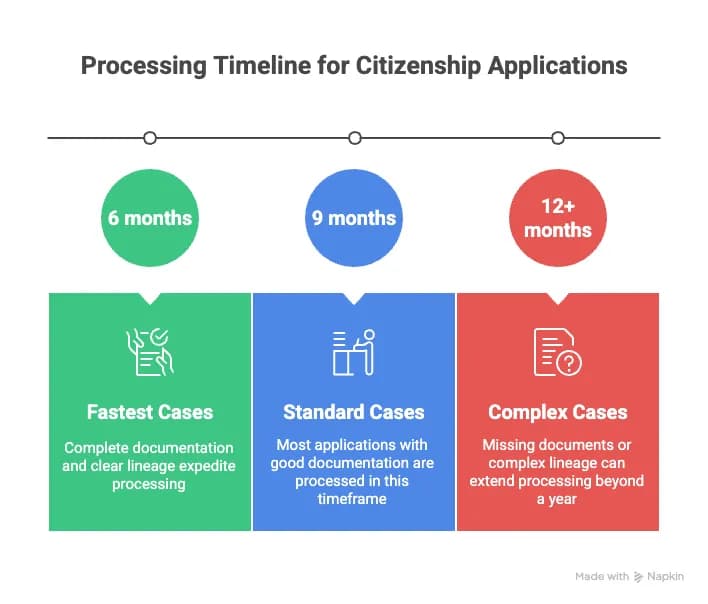
Citizenship Application Processing
Understanding the timeline and factors affecting processing
Missing birth certificates or marriage records for even one generation halts your entire application. Ensure a complete chain from ancestor to yourself.
Only sworn translators (tlumacz przysiegly) registered in Poland are accepted. Regular certified translations may be rejected.
All foreign documents must be apostilled by the issuing country. The apostille process can take weeks - complete this before submitting your application.
Consulates have specific jurisdictions based on your residence. Applying at the wrong one causes transfers and delays. Verify jurisdiction before submitting.
There's no generational limit for Polish citizenship by descent. You can trace back as many generations as needed, as long as you can provide proper documentation proving the lineage from your Polish ancestor to yourself. However, the further back you go, the more challenging it becomes to obtain the necessary documents.
If your ancestor was born in territories that are now part of Poland but before 1918 (when Poland regained independence), you may still be eligible. The key is proving that your ancestor acquired Polish citizenship after 1920 - either by being resident in Polish territory when the 1920 Citizenship Act took effect, or through later naturalization. This often requires additional historical documentation.
The Polish citizenship application process typically takes 6-12 months, depending on the complexity of your case and the completeness of your documentation. Simple cases with clear documentation may be processed faster, while complex cases involving pre-1920 ancestry or missing documents may take longer. The processing time also depends on the specific Voivode Office handling your application.
Yes, you may still qualify for Polish citizenship by descent even if your ancestor was born outside of Poland, as long as their Polish parent was a Polish citizen at the time of their birth. The key is establishing the chain of citizenship through each generation.
If you can't find your ancestor's birth certificate, there are several alternative documents that may be accepted, including marriage certificates, death certificates, military records, passport applications, or other official documents that indicate Polish citizenship. In some cases, you may need to obtain a certificate of no record from the relevant Polish civil registry office.
Your spouse cannot be included in your citizenship application, but your minor children (under 18) can be included if you're applying for confirmation of Polish citizenship. If your children are adults, they would need to apply separately. Once your citizenship is confirmed, your children inherit citizenship automatically.
If your application is rejected, you have the right to appeal the decision within 14 days to the Minister of Internal Affairs. The appeal process involves submitting additional documentation or arguments to support your case. You can also file a complaint with the administrative court within 30 days of the appeal decision.
The official application fee is relatively low (around 50-100 PLN). Additional costs include document apostilles (20-50 EUR per document), certified translations (30-100 EUR per page), and professional legal assistance ($1,000-5,000 depending on complexity). The total cost usually ranges from 500 to 5,000 EUR.
Adoption cases are complex and depend on the specific circumstances, including when the adoption occurred, whether it was formal or informal, and the legal status of the adoptive parents. Full adoption (przysposobienie pelne) by a Polish citizen can transfer citizenship. Professional consultation is strongly recommended.
You'll need to provide a complete chain of documents proving your lineage back to your Polish ancestor, including birth certificates, marriage certificates, and death certificates for each generation. All documents must be translated into Polish by a sworn translator and apostilled. The specific documents depend on the time period - see the period-specific requirements section above.
Yes, being born out of wedlock doesn't affect your eligibility for Polish citizenship by descent, as long as your Polish parent was a Polish citizen at the time of your birth. You need to establish parentage through legal documents such as birth certificate with parent named, paternity acknowledgment, or court order.
No, Polish language proficiency is not required for citizenship by descent (it is required for citizenship by naturalization). However, application forms are in Polish and all documents must be translated into Polish by sworn translators. Many consulates can assist in English.
It depends on how and when they lost it. Under the 1920 Act, citizenship was lost by acquiring foreign citizenship or serving in a foreign army. Under the 1951 Act, many emigrants were stripped of citizenship by government decree. The 2009 Act (Art. 38) allows descendants of those who lost citizenship between 1920-1999 to apply for restoration. Each case requires individual legal analysis.
Yes, for most applicants the correct legal procedure is 'potwierdzenie posiadania obywatelstwa polskiego' (confirmation of possession of Polish citizenship) under Art. 55 of the 2009 Citizenship Act. This confirms that you already ARE a Polish citizen by descent - you're not being 'granted' citizenship but having your existing status officially recognized.
Application fees vary by consulate but typically range from 50-200 EUR. Additional costs include document apostilles (20-50 EUR per document), certified translations (30-100 EUR per page), and legal consultation if needed. Total costs usually range from 300-1,000 EUR for straightforward cases, or 2,000-5,000 EUR with professional legal assistance for complex cases.
Once your Polish citizenship is confirmed, you gain the right to live and work in Poland and across the entire European Union. If you plan to settle in Poland, there are several practical steps to take. Our comprehensive moving to Poland guide covers the full process.
Your personal identification number, required for taxes, healthcare, and banking.
Meldunek (address registration) is legally required within 30 days of settling.
As a citizen, opening a Polish bank account is straightforward.
Polish income tax rates and when you become a tax resident.
Access the public healthcare system (NFZ) or choose private insurance.
How ZUS contributions work for employees and self-employed.
You can also explore renting a house in Poland, check the cost of living calculator, or browse our city guides to find the best place to settle. If you plan to work, our gross-to-net salary calculator will help you understand your take-home pay.
Begin by researching your family history and gathering the necessary documents. Check our detailed requirements and processing timeline to understand what to expect.